
The first permanent English settlement in North America started along what would be known as the James River. Here, about 100 men and boys landed in 1607 and carved out a fort. With help from the native inhabitants, the settlement grew, and this area would be fundamental to the American Revolution in the 1770s. Here are the top Historical Sites in Williamsburg.
Historical Sites in Williamsburg Virginia
- Historic Triangle in Virginia
- Colonial National Historical Park
- Historic Jamestowne
- Jamestown Rediscovery
- Jamestown Settlement
- Yorktown Battlefield
- Colonial Williamsburg
Historic Triangle in Virginia
The Historic Triangle in Virginia connects English settlements from the 1600s and 1700s. It is a 200-square-mile region with several key historical places.
The James and York Rivers bound this area, which connects to the Chesapeake Bay and then to the Atlantic Ocean. The Colonial Parkway connects the entire region, a scenic route that I used during my trip to the Historic Triangle.
Top Historical sites include the original Jamestown Settlement and the Yorktown Battlefield. I particularly enjoyed the can also iving history sites, like Colonial Williamsburg and the Yorktown Settlement.
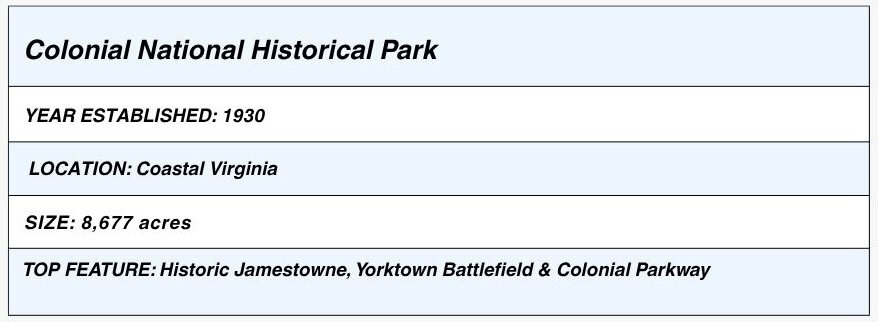
Colonial National Historical Park
This National Park Service site includes three units: Historic Jamestowne, the Yorktown Battlefield and the Colonial Parkway. The Colonial Parkway connects all the Historical Sites in Williamsburg, Virginia.
The Historic Jamestowne Settlement is the original site of the first permanent English settlement in 1607. The Yorktown Battlefield is from the American Revolution in the 1770s.
Both the Historic Jamestowne and Yorktown Battlefield feature visitor centers. At the Visitor Center, you can find maps, learn about free Ranger programs and pick up Junior Ranger booklets. There are also restrooms and gift shops. and indoor interpretive areas.
To enter the Colonial National Historical Park, admission is $15 per adult and free for kids 15-years-old and younger. This pass gets you into the Historic Jamestowne and the Yorktown Battlefield. There is no fee to drive down the Colonial Parkway.

Scenic Drives in the Colonial National Historical Park
The Colonial Parkway, a 23-mile scenic three-lane highway, connects Yorktown Battlefield, Colonial Williamsburg and Historic Jamestowne, known as the Historic Triangle..
The Colonial Parkway starts at the Yorktown Battlefield Visitor Center Parking Lot. Then it heads west, following the York River to Williamsburg. It turns south, following the James River to the Historic Jamestowne Visitor Center parking lot. The Parkway includes pull-outs to take in the scenic views and historical information plaques along the route.
It is undergoing a multi-year rehabilitation project. This area features a slower speed limit. Use caution and observe posted signs.
Kids and Pets in the Colonial National Historical Park
Traveling with your kids or pets is part of the fun. A National Park Service site makes a great trip with lots of activities and things to see. As for pets, they are welcome at the park’s picnic area, campground, in the parking lots and on the paved roads.
Junior Ranger Programs
Historic Jamestowne has three Junior Ranger Programs. The booklets are designed for kids ages 5 to 7, 8 to 10, and ages 11 and above. The programs were developed to allow families to learn together.
The Yorktown Battlefield has its own Junior Ranger Badge to earn.
BARK Program
Most National Parks welcome pets as long as they follow the BARK program’s principles. For more information, visit the park’s page for visiting with pets.
B–Bag waste and dispose of it in the trash
A–Always leash your dog for their safety and others
R–Respect wildlife
K–Know where you can go
Pets are not permitted inside the brick wall of the National Cemetery at the Yorktown Battlefield.
Wildlife in the Colonial National Historical Park
The park grounds include protected tidal saltflats, freshwater ponds and mixed pine and hardwood forests. At one point, this land was used for agriculture; however, it has since returned to a woodland environment.
Over 200 species of birds, 40 mammals, 90 fish and 50 amphibians and reptiles live within the park boundaries. Keep a lookout while exploring the area for wildlife.
- White-tailed deer
- Fox
- Raccoon
- Rabbit
- Beavers
- Otters
- Mink
- Opposum
- Skunks
-
Top Revolutionary Things to Do in Philadelphia ‘
Colonial National Historical Park at Historic Jamestowne
This is one of the National Park Service units of the Colonial National Historical Park. Historic Jamestowne is the site of the original landing of the first English settlement in North American in 1607. It features a Visitor Center and multi-use trails.
Visitors can access the archaeological site, Jamestown Rediscovery, from inside the NPS Historic Jamestowne site. It requires additional admission.
Inside the Historic Jamestowne NPS boundaries, Island Drive is a three- and five-mile figure-eight loop scenic route. Visitors can drive, hike or bike along the paved road.
Visit Historic Jamestowne
Established in 1607, Jamestowne is the first permanent English settlement in North America, named after the king at the time. There were other settlements in North America; however, this is the first English settlement in which the foundations of the U.S. would be formed.
Located on an island, Jamestown is on the James River, inland from the Chesapeake Bay. On December 6, 1606, three ships headed to North America: the Susan Constant, the Godspeed and the Discovery. On May 13, 1607, 104 Englishmen and boys landed and named the area, Jametowne, after James I of England.
The site was surrounded by water on three sides and offered deeper water for docking ships. This area was also uninhabited. By June 15, 1607, the fort was complete and protected the colonists from the Spanish.
In the early months, many of the original people died of diseases and famine. The Powhatan Indians aided the earliest inhabitants, and upwards of 90 percent of the original colonists died.
In 1612, John Rolfe arrived in Jamestown and started tobacco cultivation, which eventually became a cash crop. On July 30, 1619, Governor Yeardley called for the first representative legislative assembly, starting representative government.
Historic Jamestowne Visitor Center
Stop by the Jamestowne Visitor Center. It features maps, brochures and Junior Ranger badges. It also features an indoor interpretive area and a museum store.
Two small picnic areas are in the Visitor Center parking lot on its east end. The larger area contains eight picnic benches, and the smaller area contains four picnic benches. There are also vending machines for drinks at the visitor center.
Located at 1368 Colonial Parkway, Jamestown, VA. It is open daily from 9 a.m. to 5 p.m. Adult admission is $15 per adult and free for kids 15-years-old and younger. This pass gets you into the Yorktown Battlefield as well.
Walk the Streets of New Towne
Managed by the National Park Service, this area of Jamestown features foundations discovered by archaeologists, started by the CCC in the 1930s. This area was settled after the construction of the James Fort to accommodate the expanding settlement.
The Ambler House ruins are all that remains of the Ambler Family home, a prosperous family from the 1700s. It was a two-story Early Georgian brick house.
Angela Site is an archaeological site of the Captain William Pierce property, a planter-merchant in Jamestown. This area discusses the first enslaved people brought to English North America in 1619.

1608 Glasshouse
Capitalizing on its abundant natural resources, wood for fuel and ash and sand (silica) were used to make glass. Glasshouse is where visitors can learn more about the process and the craftspeople who worked there.
It is uncertain how successful the glassblowing was in the early 1600s. However, visitors can see modern glassblowers, in period clothing, produce common glass objects.
During my visit, I purchased a piece of hand-blown blue glass to add to my collection. I have several pieces of Jamestown glass that I have purchased at other NPS locations.
I purchased my blue glass bottle at the 1608 Glasshouse. However, the visitor center gift shop sells the glass objects blown in the park. It is open daily from 8:45 a.m. to 4:30 p.m.
Top Things to Do in Shenandoah National Park
Jamestown Rediscovery by Preservation Virginia
Preservation Virginia, a nonprofit organization, manages part of Jamestown. Jamestown Rediscovery is an archaeological project investigating the remains of the original English settlement.
Starting at the NPS Visitor Center, guests take a footbridge over a wetland, the original pitch and tar swamp. This is the beginning of the walking tour of Jamestown with several areas to see.
The NPS side and the Preservation Virginia side work side by side in Jamestowne. I walked between the two sides, took a guided tour, walked through reconstructed buildings and visited the on-site museum.

Top Sites in Jamestown Rediscovery
During my visit, I walked past several sites, including statues. The area is partially tree-covered and overlooks the water.
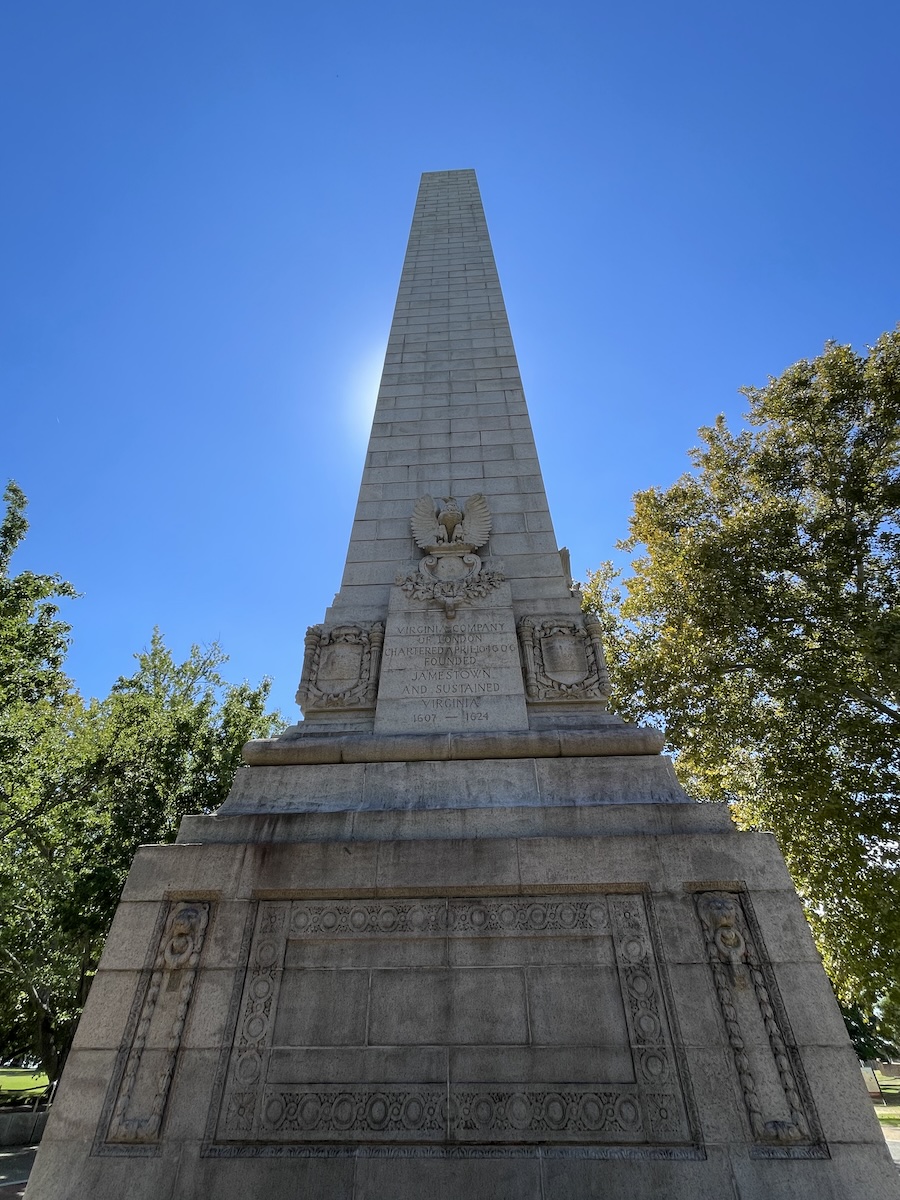
The Tercentennial Monument celebrates the 300th anniversary of the Jamestown Settlement, erected in 1907. It resembles the Washington Monument in DC.
The Ponchatas Statue commemorates the woman who helped the Jamestown settlers.
The 1907 Memorial Church mimics St. Luke’s Church in Smithfield. Inside, visitors will find glass panels with original church foundations below.
The 17th-Century Church Tower is the only remaining above-ground structure still remaining from the original days of Jamestown.
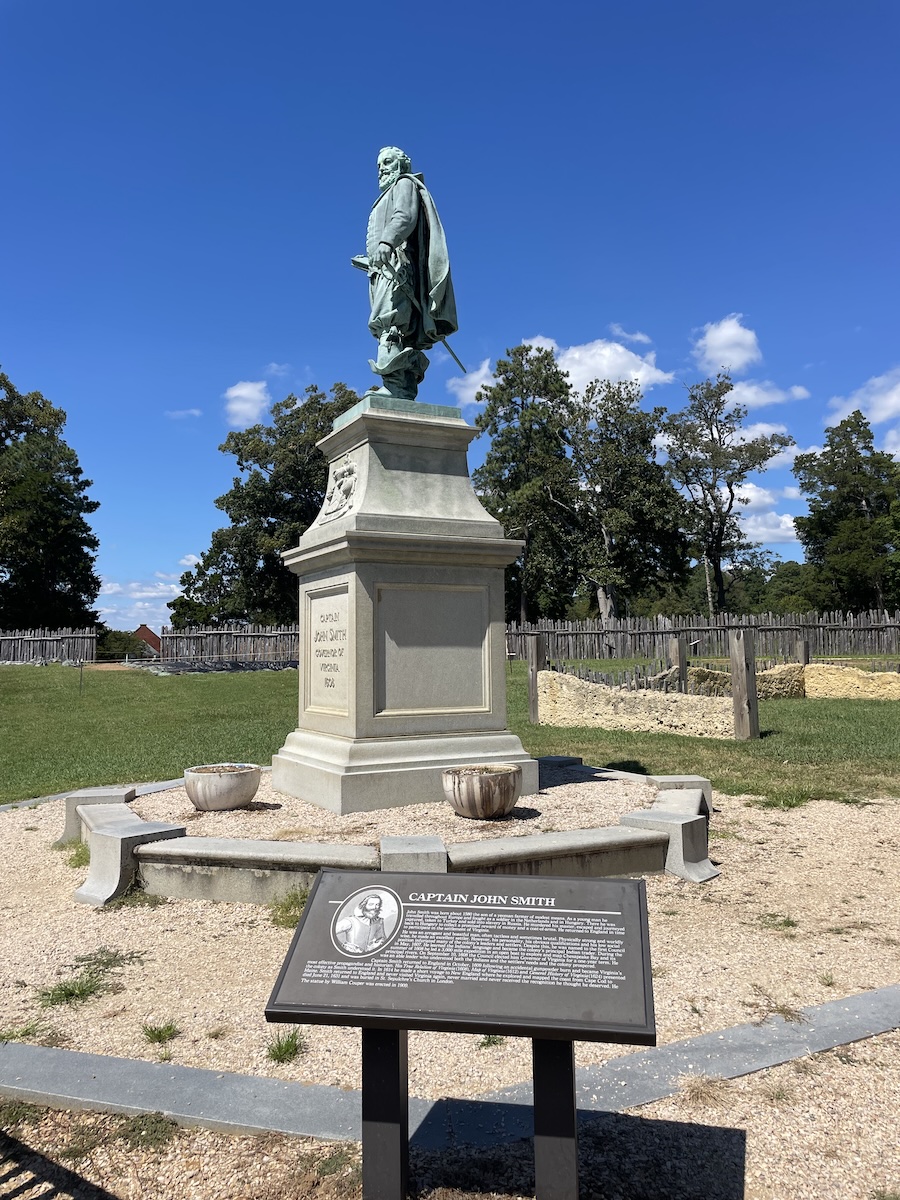
The John Smith Statue is within the original site of Fort Smith. The statue overlooks the water. He was an English explorer and the leader of Jamestown from September 1608 to August 1609, helping the colonists survive.
The Hunt Shrine was erected in June 1922 to commemorate the earliest celebration of the Holy Communion in the first permanent English settlement in America by Reverend Robert Hunt.

Building in the Jamestown Rediscovery
Fort Smith was originally built in 1607 as a triangular defense. The area is now a collection of foundations, uncovered by years of archaeological digs.
The Ed Shed is an area where kids can learn more about Jamestown and archaeology, such as ground-penetrating radar (GPR) technology. Kids can tour real artifacts, like pottery shards, see 17th-century food remains and do hands-on experiments.
Open from late May to August 1, from Tuesday to Saturday, from 9 a.m. to 4:30 p.m. The neighboring Dale House Cafe is closed for renovations.
The Statehouse served as Virginia’s legislative seat from 1607 to 1699. The Statehouse was the only building at Jamestown constructed to house the General Assembly.
Voorhees Archaearium Archaeological Museum houses more than 4,000 artifacts. Exhibits include The World of Pocahontas, Unearthed, which highlights objects used by Virginia Indians.
During my late summer visit, I toured the museum and found it interesting. It retells the timeline of Jamestowne and the exhibits offer a nice break in the middle of the day.
There are several active excavation sites in the Jamestown Rediscovery area. The locations change with the season.
Located at 1365 Colonial Nat’l Historical Pkwy, Williamsburg, VA. It is open daily from 9 a.m. to 5 p.m. Jamestown Rediscovery requires its own entrance fee of $15 per adult and $5 for kids 6 to 15. Living History Demonstrations are held from Thursday to Saturday. Historic trades programs, such as blacksmithing and woodworking, are offered on Saturdays and Sundays.
Top Things to Do at New River Gorge National Park and Preserve in West Virginia

Jamestown Settlement by Jamestown-Yorktown Foundation
Close by, the Jamestown-Yorktown Foundation manages the Jamestown Settlement. This recreated space includes an outdoor living-history interpretive area.
Guests can explore the visitor center, which features interpretive displays and artifacts. It shows the educational film 1607: A Nation Takes Root every 30 minutes.
During my visit, I really enjoyed the outdoor living history area. I explored the replicas of the original ships used by the Jamestowne settlers: the Susan Constant, the Godspeed and the Discovery.
Other areas to explore include Paspahegh Town, a historic, Algonquian-speaking Powhatan village. They were coastal Virginia’s original inhabitants.
There is also a recreated James Fort from 1610-14. This recreation helps visitors learn how the colonists would have lived.
During my visit, I took a tour, led by an area historian. This tour focused on women in the colony and offered insight to a different era. When you arrive, you can check to see if are any scheduled programs. Mine was included in the price of admission.
Located at 2110 Jamestown Rd, Williamsburg. Open daily from 9 a.m. to 5 p.m. Adult (13 to 61) admission is $20, youth (6 to 12) is $10, with those 5 and younger entering for free. A multi-day combo ticket with the American Revolution Museum at Yorktown is $34.00 for adults (13 and older) and $17 for youth (6 to 12).
If your family wants to visit all five sites, the America’s Historic Triangle Ticket is the one for you. It allows unlimited entrance to all five sites over five consecutive days: the three living history museums and the two NPS sites. Adult admission (16+) is $126, youth (6-15) are $74 and those 5 and younger enter for free.

Yorktown Battlefield, part of Colonial National Historical Park
This is the historic battlefield from the last major battle of the American Revolution. This site includes several buildings from the era, a driving route through the battlefield and a visitor center.
In Fall 1781, General George Washington, the Revolutionary soldiers and the French soldiers besieged General Charles Lord Cornwallis’s British army. On October 19, Cornwallis surrendered, ending the war.
Stop by the Yorktown Battlefield Visitor Center
In the visitor center, guests can see the 15-minute orientation film, “The Siege at Yorktown,” shown every hour and half-hour. They can also get brochures and talk to a park ranger or volunteer.
The Yorktown Battleview exhibits focus on the 1781 Siege of Yorktown and the Battle of the Capes, also known as the Battle of the Chesapeake, which occurred on September 5, 1781.
Visitors will also find the campaign table used by British General Cornwallis during the siege. General Washington’s Campaign Tents are also on display inside the museum.
Located at 1000 Colonial Parkway, Yorktown. It is open daily from 9 a.m. to 5 p.m. This is where you pay for park admission. Adult admission is $15 per adult and free for kids 15-years-old and younger. This pass gets you into the NPS Jamestown Settlement.
Drive the Yorktown Battlefield Red Route Auto Tour
The 7-mile red route will pass major sites of the Siege of Yorktown with six stops. Stops include the British Inner Defense Line, the Grand French Battery, the Moore House, the Surrender Field and more.
There is a free downloadable app for Yorktown, including the battlefield. The Yorktown Battlefield Red Route starts at the Visitor Center. The routes are open from 9 a.m. to sunset, year-round. Visitors can drive, hike or bike and they divided into the red and yellow routes. Horseback riding is even permitted in this location.
Take a Tour
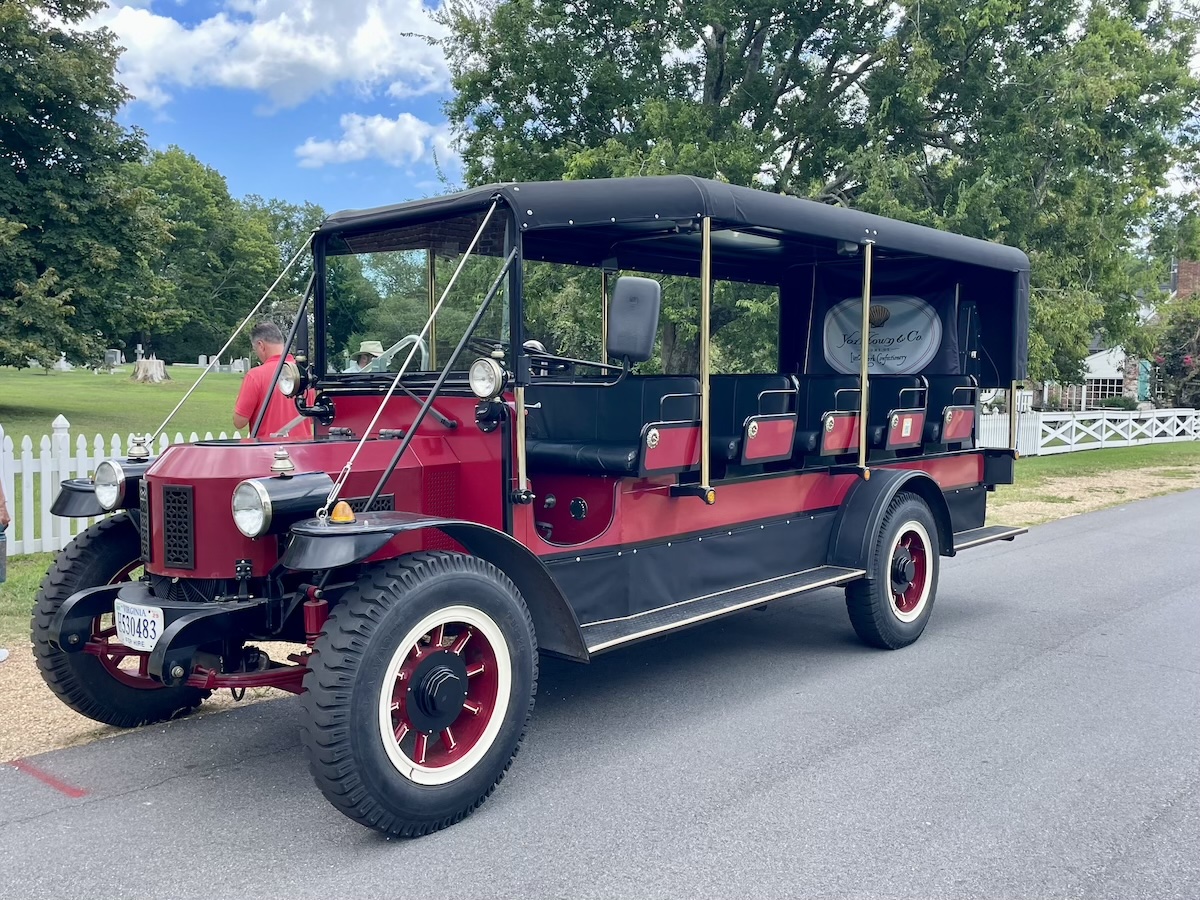
During my visit, I took a guided tour on the open-air steamer. This tour includes a full hour of historic commentary as the driver takes you to the sites in the park.
My guide was a history buff and added a ton of information. This tour is great for families, history buffs and everyone in between.
Departs from the Little York Confectionary at 401 Main Street, Yorktown. Free parking is located nearby. Adult tours are $65, $25 for kids 5 to 15 and $5 for those 4 and younger. Reservations are required.
Take the Yorktown Battlefield Yellow Route Auto Tour
The Yorktown Battlefield Yellow Route Auto Tour is a 9-mile drive that takes visitors through the Allied Encampment areas. It was used by the American and French troops for sleeping, drill practice and storing artillery and other equipment.
This tour begins at the Surrender Field of the Battlefield Tour. Bikes can use both auto routes.
See The Moore House
During the Battle of Yorktown, commissioners met at the Moore House to negotiate the terms of surrender. British Lt. Col. Thomas Dundas and British Major Alexander Ross met with French Army Officer Viscount de Noailles (Lafayette’s brother-in-law) and American Revolutionary Colonel John Laurens.
It is along the Yorktown Battlefield Red Route. It is closed for tours, but the grounds are open.
Walk Down Main Street in Yorktown
Visitors will see 18th-century buildings along Main Street. The Nelson House is a Georgian Manor-style home of Thomas Nelson. He was Yorktown’s most famous son and one of the signers of the Declaration of Independence. It is open when staffing allows.
The Dudley Digges House, the Smith and Ballard Houses are also in the area. The Customhouse is along Main, where taxes were collected from imports. Grace Church is on a nearby street. The reconstructed Swan Tavern is where residents gathered.
Maps are available at the Visitor Center.
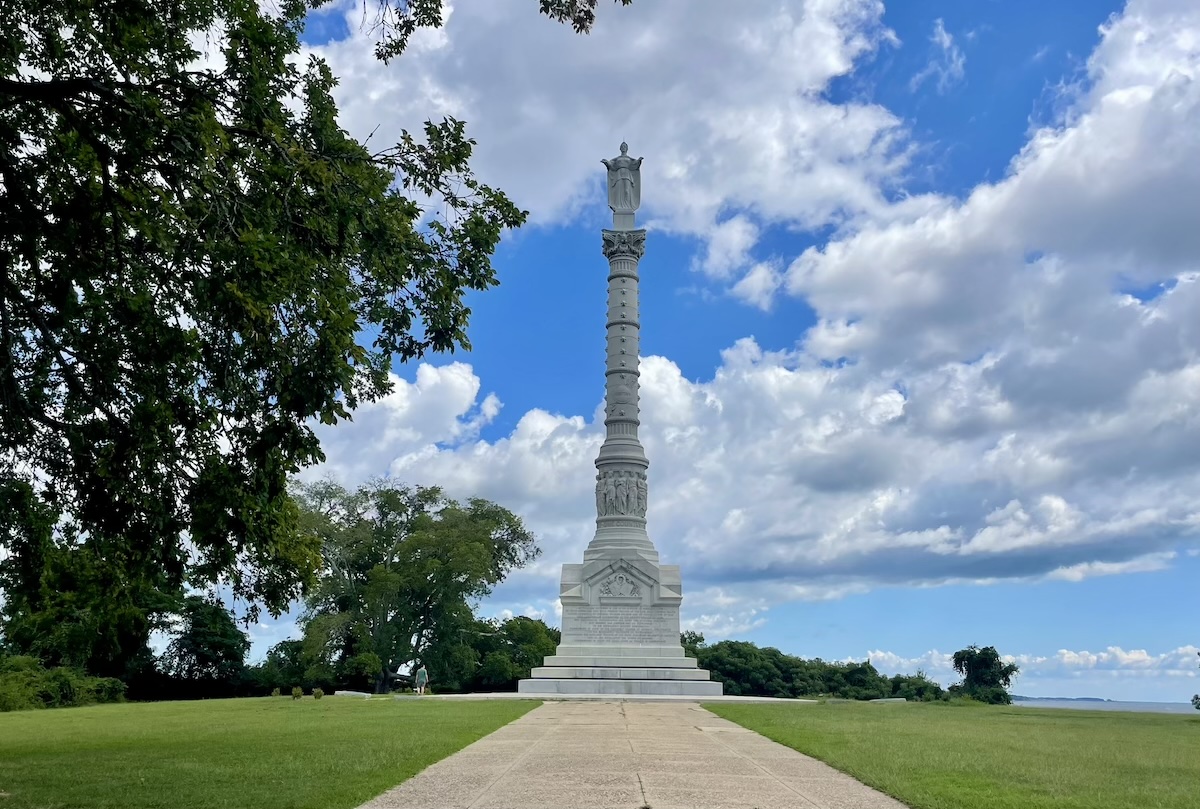
Stare up at The Yorktown Victory Monument
The Victory Monument commemorates the Victory at Yorktown on October 19, 1781. The French and American forces ensured American Independence.
Designed by famed architect Richard Morris Hunt, the monument was installed in 1884. It is approximately 98 feet tall.
Located at the corner of Ballard and Main Streets in Yorktown, about 500 yards from the Visitor Center.
Fife and Drums of Yorktown Performances
Fife and drum music was vital to Revolutionary military life, as it was used to communicate when soldiers were to rise, eat and sleep. The fife is a short flute, played to the side.
The Fifes and Drums of Yorktown will play Revolutionary War-era fife and drum music at the Victory Monument in Yorktown. These are primarily during the summer season.
The National Cemetery and the Cemetery Lodge
The Yorktown National Cemetery was officially established in 1866. It was used to inter Civil War soldiers during the Federal occupation in 1862.
The Cemetery Lodge was designed by U. S. Quartermaster General Montgomery C. Meigs and features the distinctive mansard roof common to the Second Empire style. It includes Civil War exhibits.
It is along the Yorktown Battlefield Red Route Auto Tour, and the lodge is open when staffing permits.
The Poor Potter
In the early 18th century, a pottery manufacturing site was located at Yorktown. Visitors can see the archaeological ruins of the site.
There are interpretive signs, and the kiln can be viewed through glass when the site is closed. The building is open as staffing permits. The grounds are open for visitation.
See the Artillery Fire
Costumed Royal Artillery soldiers fire 6-pounder brass cannons once a month from June to October at 10:45, 11:45 a.m. and 12:45 p.m.
- Saturday, October 17 and Sunday, October 18, 2026
The American Revolutionary forces fire their cannons at 1, 2 and 3 p.m.
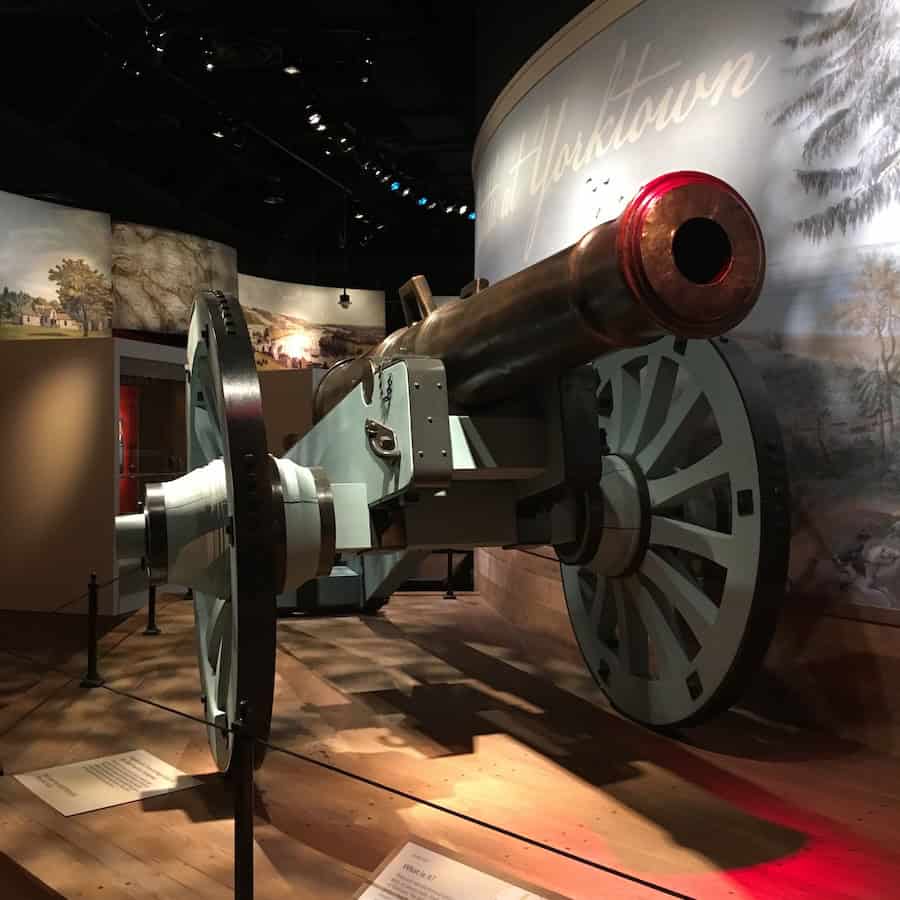
American Revolution Museum at Yorktown
Operated by the Jamestown-Yorktown Foundation, the American Revolution Museum at Yorktown is a 22-acre site dedicated to the American Revolution. It features a visitor center and indoor museum exhibits and an outdoor living history area with costumed interpreters.
Inside its visitor center, visitors can see educational displays on the Declaration of Independence. Its indoor space chronicles America’s evolution from British Colonies in the 1750s to an independent nation in the 1790s.
It also explores the American ideal of liberty. During my visit, I saw artifacts from weaponry to housewares to uniforms.
Located near the Yorktown Battlefield, you can watch the interpretive film Liberty Fever, shown every 30 minutes in the theater. There are period artifacts as well.

Living History Demonstrations
During my visit, one of my favorite activities was exploring its outdoor living history area. It includes a Continental Army encampment. While I was there, I learned about Colonial-era medicine.
Daily demonstrations, including artillery shooting, also depict the daily life of soldiers during the American Revolution. The Revolution-era farm depicts a rural lifestyle of the time period with seasonal crops.
I saw one of the cannons loaded and discharged, always a crowd-pleaser. I also learned about the muskets used at the time with a demonstration.
Located at 200 Water St, Yorktown, adjacent to the Colonial National Historical Park. Open daily from 9 a.m. to 5 p.m. Adult (13 to 61) admission is $20, youth (6 to 12) are $10, with those 5 and younger entering for free. A multi-day combo ticket with the Jamestown Settlement is $34.00 for adults (13 and older) and $17 for youth (6 to 12).
If your family wants to visit all five sites, the America’s Historic Triangle Ticket is the one for you. It allows unlimited entrance to all five sites over five consecutive days: the three living history museums and the two NPS sites. Adult admission (16+) is $126, youth (6-15) are $74 and those 5 and younger enter for free.

Colonial Williamsburg
The largest living history museum in the US, where costumed interpreters bring the 18th-century colonial capital to life. Colonial Williamsburg is a 301-acre sites includes 89 original 18th-century buildings and several hundred recreated buildings from the 18th century, according to original plans.
Colonial Williamsburg includes three main thoroughfares and connecting side streets. It is designed to represent how Williamsburg existed in the 18th century.
The main streets are Duke of Gloucester Street and Francis Street. Palace Green is flanked by historic sites, some with historical demonstrations. The Governor’s Palace and Gardens are located at the end.
Remember, Colonial Williamsburg is pedestrian-only.
Government Buildings at Colonial Williamsburg
There are several government buildings to tour in Colonial Williamsburg. These were used first under British rule; after the American Revolution, the new U.S. Government used them.
Governor’s Palace is the home to the Royal Governors during Colonial times and the first two Governors of the State of Virginia. Visitors can take a guided tour from 10 a.m. to 4 p.m.
The Governor’s Palace also includes a garden and formal landscaped grounds. Located at 300 Palace Green St.
The Capitol was the center of British authority in Virginia for most of the 18th century. It was the epicenter of the American Revolution with Thomas Jefferson and George Washington amoung others using the building. Visitors can tour the Capitol.
Located at 500 E Duke of Gloucester St.
Colonial Williamsburg features an original 18th-century courthouse. There is also a gaol, or jail.
Art Museums in Colonial Williamsburg
There are two art museums at one location in Colonial Williamsburg: the Abby Aldrich Rockefeller Folk Art Museum and the DeWitt Wallace Decorative Arts Museum.
The folk art museum is the oldest institution dedicated to preserving, collecting, and exhibiting art made by self-taught artisans. There is an assortment of objects
The DeWitt Wallace Decorative Arts Museum features both British and American antiques and decorative items from the 17th to the 19th centuries.
Located at 301 South Nassau St., Williamsburg. Open daily from 10 a.m. to 5 p.m.
Play House Stage
Before 1720, Colonial Williamsburg built an open-air theater. Check the calendar of events for scheduled productions during your visit.
Located at 208 Palace Green Street.
Community Buildings in Colonial Williamsburg
Colonial Williamsburg included buildings for community use. From Taverns to a school to a hospital, many of the spaces have been restored or recreated.
Charlton’s Coffeehouse was a gathering place during Colonial times. Visitors will learn about the Stamp Act while they enjoy samples of coffee or tea.
Located at 429 E Duke of Gloucester St. Open daily from 10 a.m. to 5 p.m.
The Williamsburg Bray School was a school for enslaved children during Colonial Times. Children between 3 and 10 learned to read, and the girls learned to sew.
Located at 105 S Nassau St, Williamsburg.
The Public Hospital of 1773 was the first mental hospital in British North America. It is located at 325 Francis St. W, Williamsburg.
Raleigh Tavern was established around 1717. Taverns were gathering spaces that offered food, drink, lodging and boarding for horses. In the Apollo Room, many conversations occurred leading up to the American Revolution. Located at 413 East Duke of Gloucester St., Williamsburg.
Market Square was a hub of buying and selling in 18th-century Williamsburg. Located at 100 E Duke of Gloucester St.
Presbyterian Meetinghouse is located at 531 Francis St. E, Williamsburg.
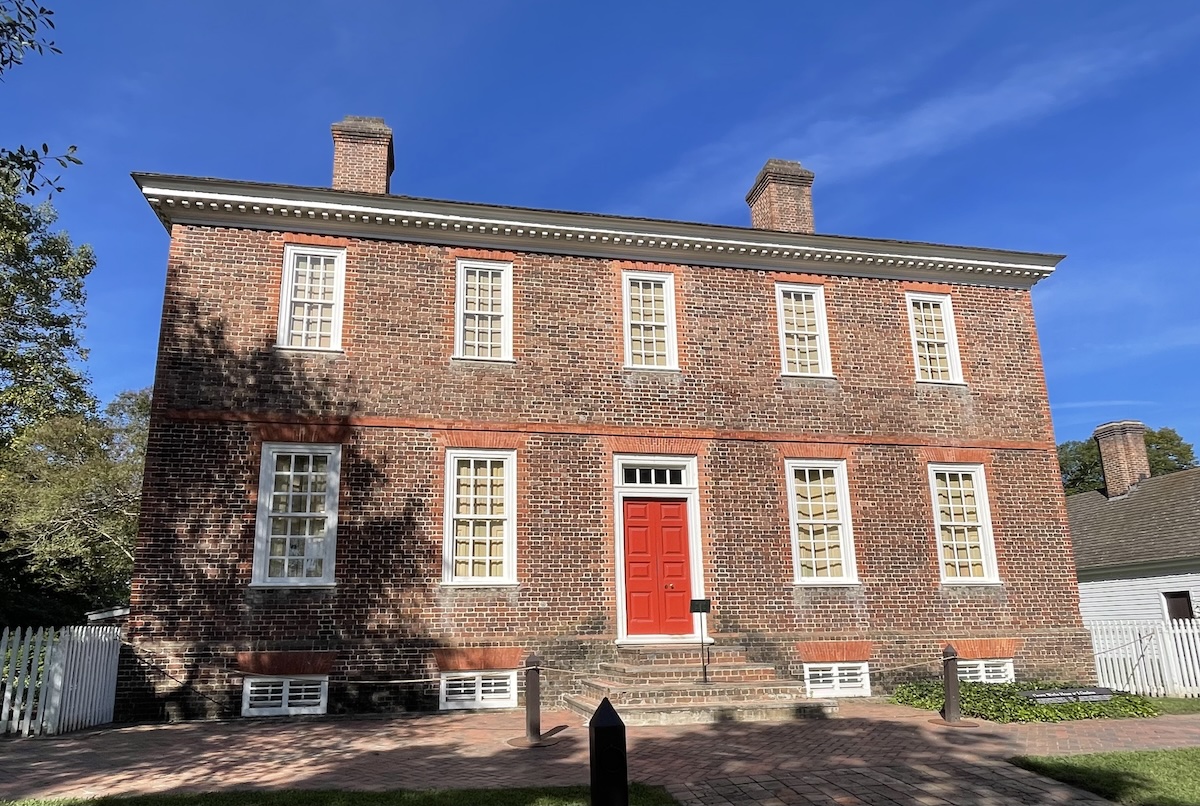
Historic Homes in Colonial Williamsburg
Visitors can tour historic homes while in Colonial Williamsburg.
George Wythe House was designed and built by Richard Taliaferro, an architect. His daughter married George Wythe and gifted the house to them.
Wythe was a lawyer and taught law in the house, and one of his students was Thomas Jefferson. Both would sign the Declaration of Independence. This house was also used as Washington’s headquarters.
Located at 101 Palace Green St, Williamsburg. Open for self-guided tours.
James Geddy House—built by James Geddy, Jr. and his wife Elizabeth and their five children. Located at 117 W Duke of Gloucester St., Williamsburg. Open for self-guided tours.
Peyton Randolph House—built by Peyton Randolph, speaker of Virginia’s House of Burgesses and President of the First Continental Congress. Part of the house dates back to 1715, and one of the oldest surviving buildings in Williamsburg.
He lived there with his family and 27 enslaved people. Located at 100 W Nicholson St., Williamsburg. Open for self-guided tours.
John Carter House is unfurnished and located at 209 Palace Green St., Williamsburg. It is open for scheduled tours.
The Rockefellers’ Bassett Hall—This is one of the 88 original surviving buildings in Colonial Williamsburg. The visionary, Rev. Dr. W.A.R. Goodwin, showed this property to John D. Rockefeller, Jr, in 1926 to entice Rockefeller to help fund the restoration.
Located at 522 Francis St. E, Williamsburg. It is open for guided tours on select dates, usually weekends.
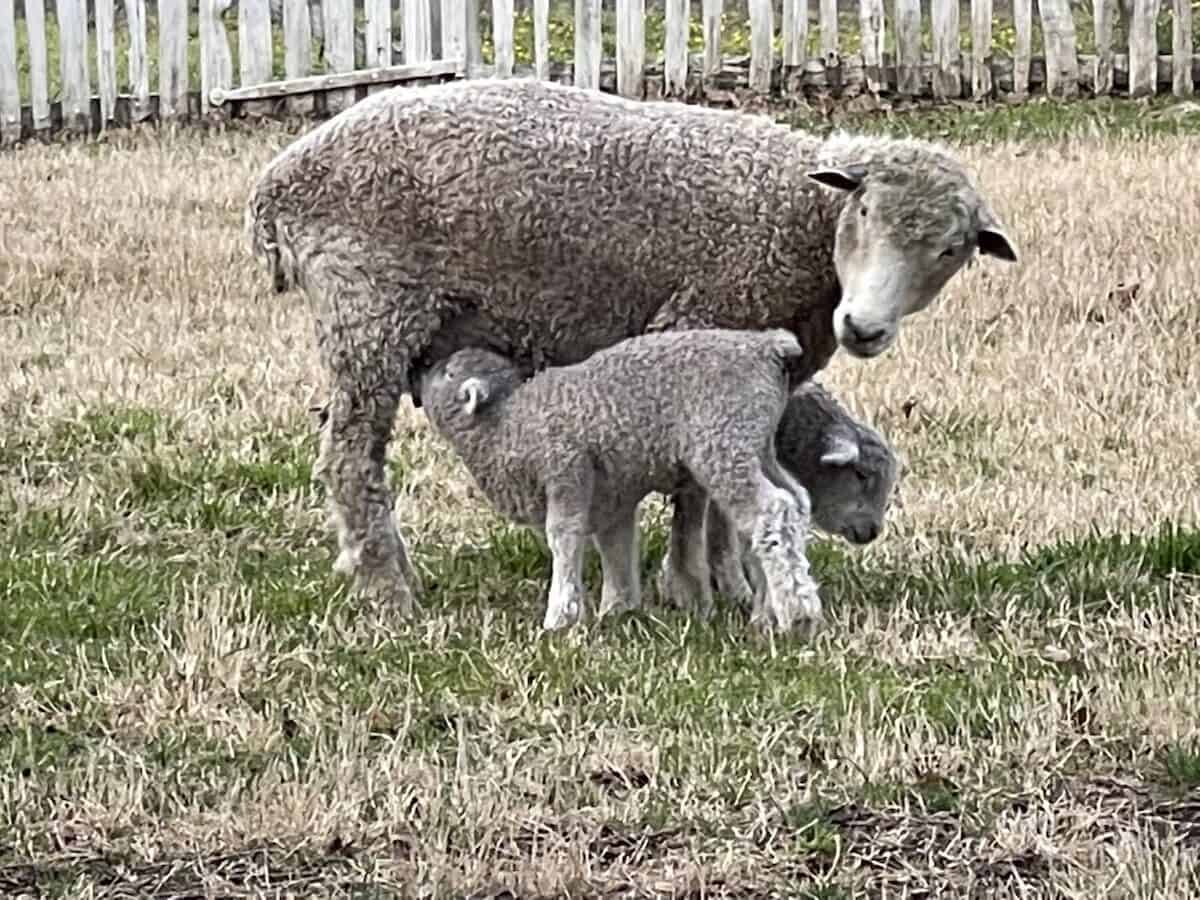
Historic Livestock in Colonial Williamsburg
Colonial Williamsburg is home to historical livestock breeds. Over time, some breeds fall out of favor, or newer breeds are developed for favorable traits. There are 100 rare breed animals in the historic area, from lambs to cows to chickens to horses.
Colonial Williamsburg has 30 landscaped historic gardens. They range from flowering gardens to the grand Governor’s Palace Gardens and Grounds. Some of the food served in the restaurants is grown on-site.
Where to Eat in Williamsburg
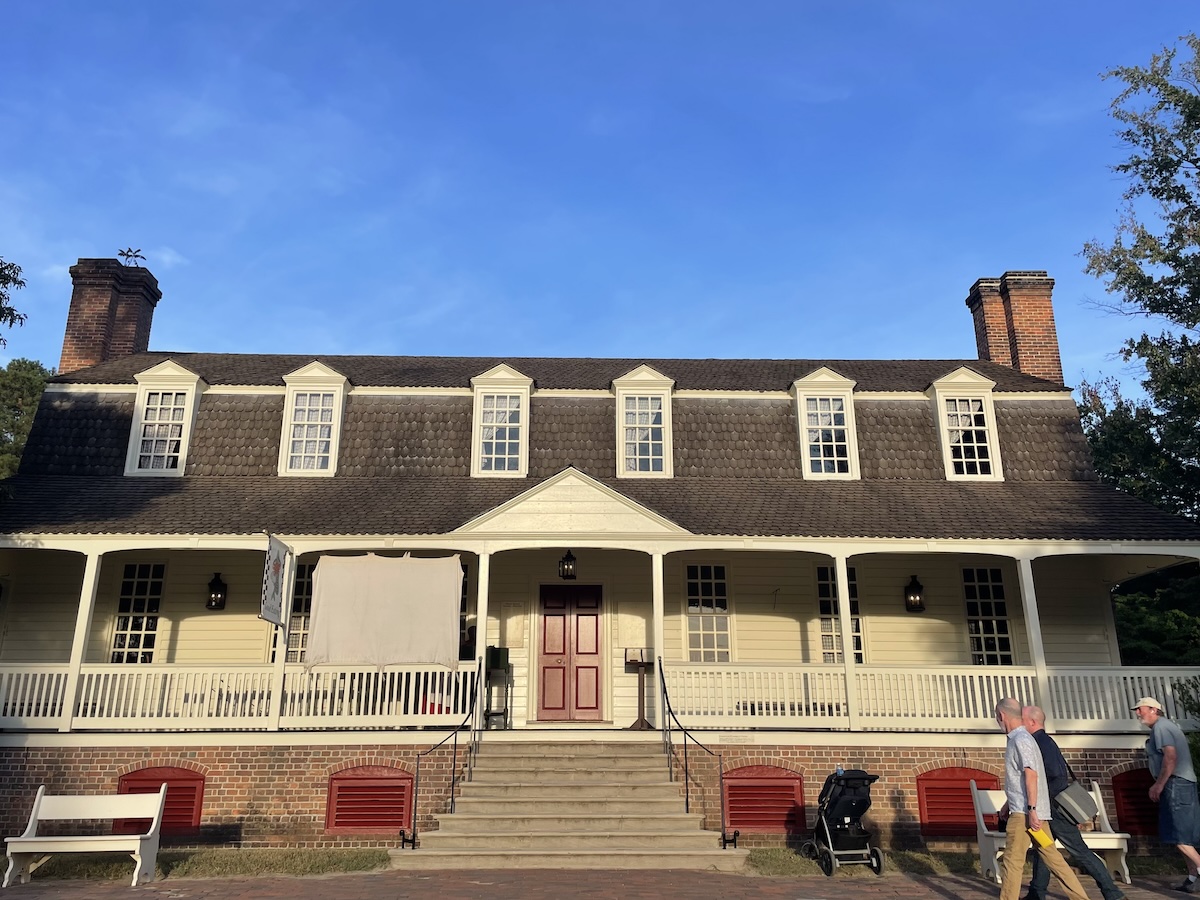
Colonial Williamsburg features historic taverns that serve food inspired by what the Colonists ate in the 18th century. At one point, Williamsburg had seven taverns that were used by residents and tourists.
Christiana Campbell’s Tavern
General George Washington’s favorite for seafood, Christiana Campbell’s Tavern serves a historically inspired, locally sourced seafood menu. However, there is beef and chicken on the menu. There’s also a kids menu.
Located at 101 South Waller St. Open Tuesday to S 4 to 8 p.m. Reservations are encouraged.
King’s Arms Tavern
Established by Jane Vobe in 1772, the King’s Arms Tavern features servers dressed in period attire. It serves colonial recipes, such as beef, pork and Cornish hen. There’s also kids menu.
Located at 416 East Duke of Gloucester St., Williamsburg, VA. Open Thursday to Monday for lunch 11 a.m. to 4 p.m. and dinner from 4:30 to 8 p.m.
Shields Tavern
Opened by Jean Marot in 1709, then by his daughter and husband, Anne and James Shields. Traditionally, some taverns served food family-style, and Shield’s Tavern offers a Groaning Board for lunch.
Located at 422 East Duke of Gloucester St., Williamsburg, VA. Open from Tuesday to Saturday from 11 a.m. to 2 p.m.
McKenzie Apothecary serves coffee, tea and baked goods near the Governor’s Palace.
Located at 207 Palace Green St. Open Wednesday to Sunday from 9 a.m. to 4 p.m.
Evening Activities at Colonial Williamsburg
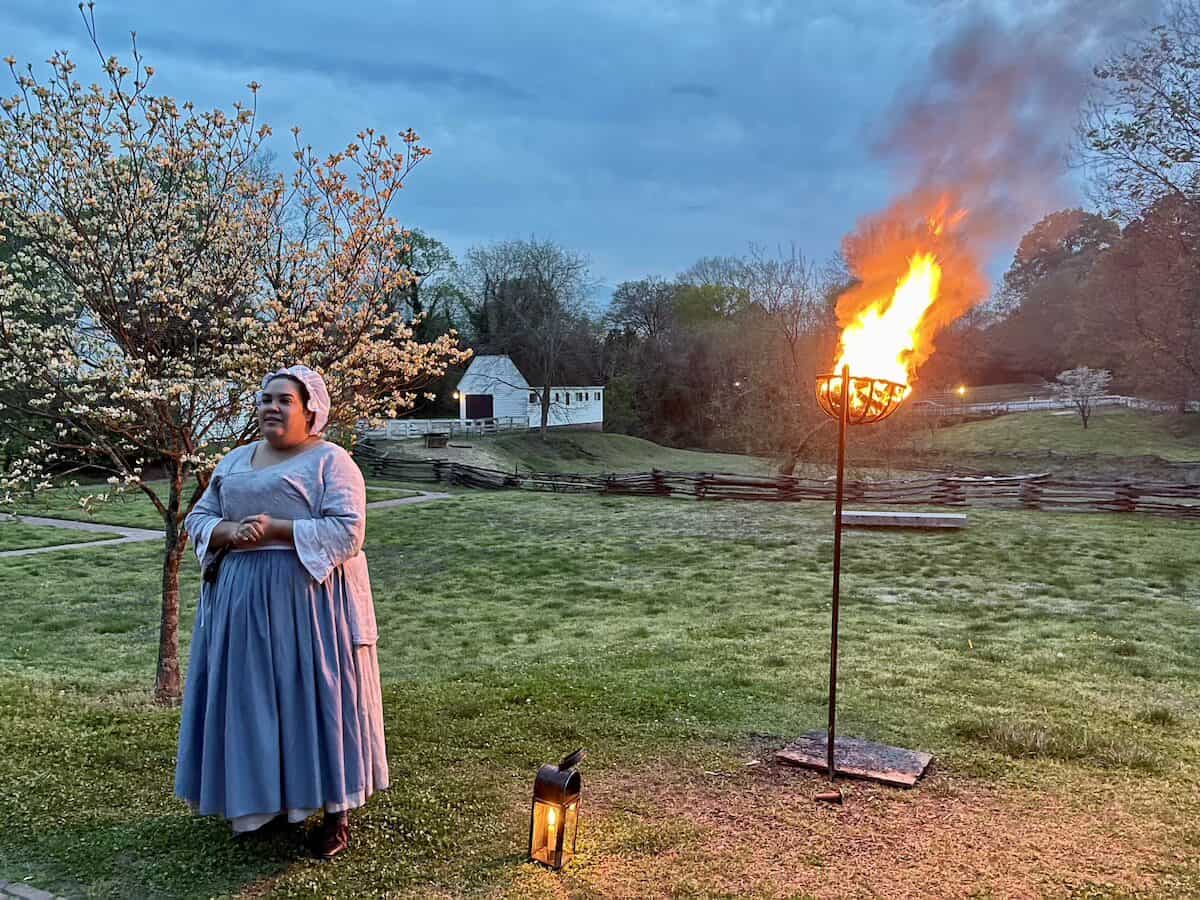
From evening dinner reservations to a Haunted Williamsburg tour, there are planned activities in the evenings.
The Haunted Williamsburg Tour is the official haunted program that enters the historic buildings. More historical than haunting, additional tickets are required. Admission is $20 per person, and reservations are required.
The Kimball Theatre opened in 1933 as a Radio-Keith-Orpheum (RKO) and has been home to the performing arts in Colonial Williamsburg ever since. Located at 428 W Duke of Gloucester St.
Getting Around Colonial Williamsburg
You can park at the Colonial Williamsburg Visitor Center, where parking is available for $10 per day at 101 Visitor Center Drive. Worth noting, this is not next to Colonial Williamsburg.
There is a complimentary bus service on the Williamsburg Area Transit Authority or WATA Route 15, with several stops in Colonial Williamsburg at The Capitol, The Tavern, Market House, Museums and Merchants Square.
Buses go by every 15 minutes. The buses run Monday through Saturday from 9 a.m. to 9 p.m. and Sunday, 9 a.m. to 6 p.m. Visitors with dinner reservations and evening activities can park at the tavern parking lot off of Francis Street.
Admission tickets are required to enter buildings and experience programming in the Historic Area. One day, adult tickets are $37.50 and kids (6 to 12) are $10. They can be purchased in advance or on-site.
America’s Historic Triangle Ticket
If your family wants to visit all five sites, the America’s Historic Triangle Ticket is the one for you. It allows unlimited entrance to all five sites over five consecutive days: the three living history museums and the two NPS sites. Adult admission (16+) is $126, youth (6-15) is $74, and those 5 and younger enter for free.
Where to Stay in Williamsburg
Rochambeau Roadside Inn
Located at 929 Capitol Landing Rd, Williamsburg, VA.
Disclosure: Visit Williamsburg hosted me during my visit. This article contains affiliate links.

Comments are closed.