King Charles II gave William Penn a massive land grant in 1682 to settle a debt, and Penn used Quaker ideals to create Philadelphia as a green country town. Philadelphia is located between the Delaware and Schuylkill rivers, and by the 1750s, it was the second-largest city in the British Empire. Within its alehouses and taverns, residents, including Benjamin Franklin, began discussing independence. Here are the Best National Park Sites in Philadelphia to learn about the American Revolution and Colonial history.
Best National Park Sites in Philadelphia
Learn about the American Revolution
Start at the Independence National Historical Park
Walk through Independence Square
Walk through the Independence Visitor Center
Tour Independence Hall
See the Congress Hall
Visit the Liberty Bell Center
Tour the Betsy Ross House
Visit the Museum of the American Revolution
Walk Down Elfreth’s Alley
See Benjamin Franklin’s Grave at the Christ Church Burial Ground
Tour the National Constitution Center
VIsit Benjamin Franklin Museum
National Park Sites in New York City

From British Rule to American Freedom: Learn about the Revolution
Rooted in pacifism and religious tolerance, Philadelphia’s name translates to brotherly love in Greek. It was the largest city in the American Colonies.
By the mid-1700s, the British Parliament began taxing the Colonies without a representative vote. It began with the Stamp Act in 1765 and the Townshend Acts in 1767.
Tensions boiled over after the Boston Massacre in 1770, in which British Soldiers killed five colonists. The Boston Tea Party came after the Tea tax in 1773. Then came the Intolerable Acts in 1774. The First Continental Congress convened in Fall 1774, with the first shots of the American Revolution fired at Lexington and Concord in April 1775.
The Second Continental Congress signed the Declaration of Independence in Philadelphia at Independence Hall, then known as the Pennsylvania State House, on July 4, 1776. Eleven years later, delegates to the Constitutional Convention created and signed an enduring framework of government, the United States Constitution.
Start at the Independence National Historical Park
This 55-acre National Park Site preserves the history of the American Revolution. In Independence Hall, both the Declaration of Independence and the U. S. Constitution were signed by the Founding Fathers, including George Washington, Thomas Jefferson and Benjamin Franklin. Located in the Old City and Society Hill neighborhoods, visitors will find the Independence National Historical Park. a collection of buildings to tour, including the actual Liberty Bell with its remaining crack.
Independence Visitor Center
Always a good first stop, the Independence Visitor Center is where you will find Park Rangers, park brochures and a large map to orient yourself to the park’s sites. It also offers a bookstore, three short interpretive films in its theater and restrooms.
Visitors can learn about signing the US Constitution. There is also a replica of the crack in the Liberty Bell. This center opened in 2001.
Located at 599 Market St, Philadelphia. This space does not require reservations to enter. Open daily from 9 a.m. to 5 p.m.
Independence Square
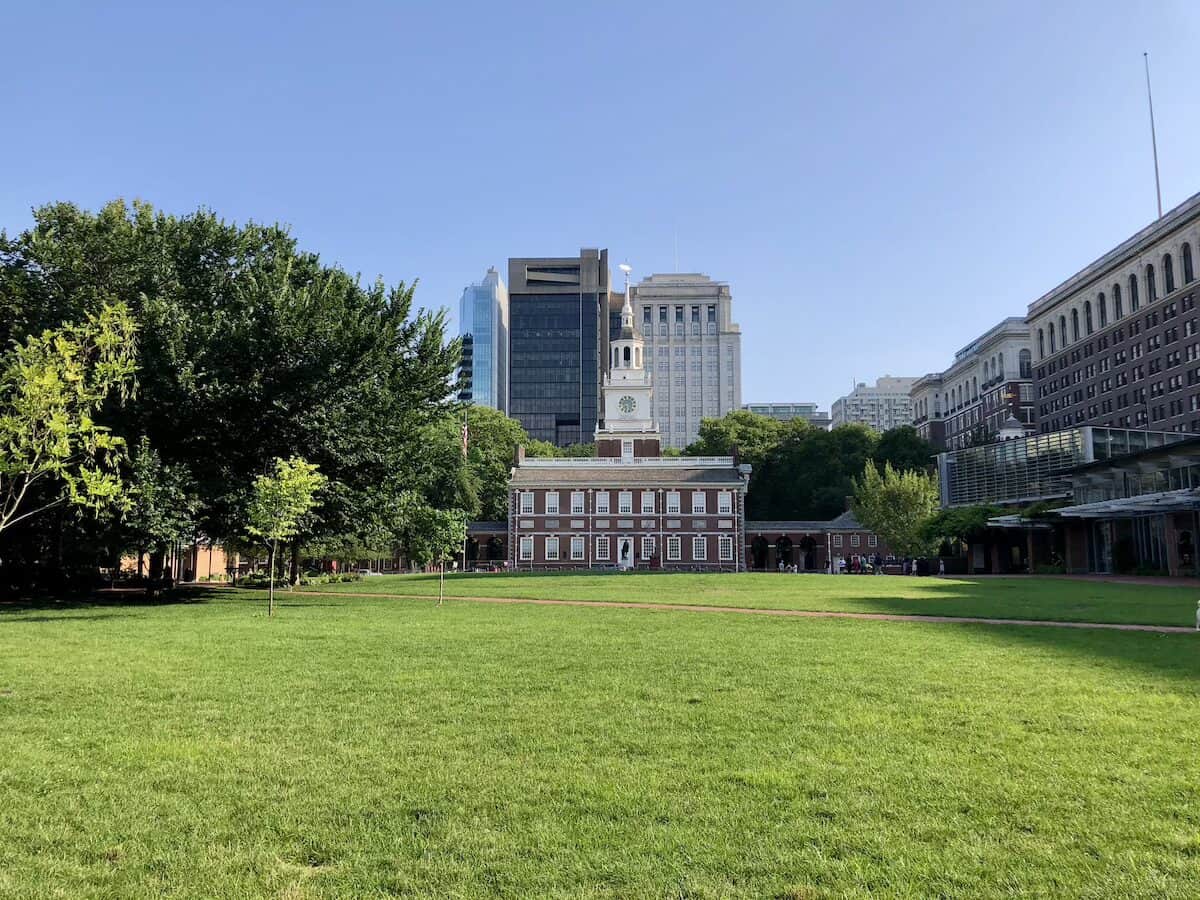
Between Chestnut and Walnut Streets, and 5th and 6th Streets, Independence Square is a grassy park in front of Independence Hall.
Located at 111 S Independence Mall W, Philadelphia. Free to enter.
How to Tour the FDR House and Library in Hyde Park NY

Independence Hall
Independence Hall is where the Founding Fathers of the U.S. debated and signed the Declaration of Independence and the U.S. Constitution in the 1770 and 1780s.
Independence Hall is the largest building in the middle of the block. It was constructed in 1733 in the American Georgian style and used as the capitol of the Pennsylvian Colony.
Designated a UNESCO World Heritage site since 1979, it is also a National Historic Landmark. Guided tours last about 20 to 30 minutes and are led by a Park Ranger through the Assembly Room. Advance reservations are required.
Located at 520 Chestnut St. It is open daily from 9 a.m. to 5 p.m. From 9 a.m. to 9:50 am, visitors can enter without reservations for the tour. From 10 a.m. to 4 p.m., tours depart every 20 minutes, and tickets are required. At 4:20 pm, there is an expanded tour to the second floor. Tickets are required, and the tour is not accessible. Free to enter, but the reserved tour fee is $1 and available through the NPS ticket portal. All visitors and their belongings are required to undergo screening to enter Independence Hall.
Congress Hall
Built as the Philadelphia County Courthouse, Philadelphia served as the temporary capital of the United States from 1790 to 1800. The Congress Hall building was home to the U.S. Congress and the U.S. Senate during that time.
Located at 600 Chestnut Street, Philadelphia. Open from 9 a.m. to 5 p.m.
West Wing of Independence Hall
The West Wing sits just west of Independence Hall. It features original 18th-century copies of the Declaration of Independence, the Articles of Confederation and the U.S. Constitution in the Great Essentials display.
Entrance is first-come, first-served. However, this display is closed for renovation and is expected to reopen later in 2026.
Old City Hall
The Old City Hall was the home of the U.S. Supreme Court in the 1790s. Visitors can tour an 18th-century courtroom furnished with artifacts from the time period.
Located at the corner of 5th and Chestnut Streets. Open daily from 9 a.m. to 5 p.m. Free to enter and no reservations are required.
Philosophical Hall
East of Independence Hall, Philosophical Hall is the home of the American Philosophical Society. Founded in 1743 by Benjamin Franklin, the Georgian-style building was constructed in 1789.
It changes is exhibition annually. For 2026, it is displaying: These Truths: The Declarations of Independence
Located at 104 S 5th St, Philadelphia. Open from April to December from Thursday to Sunday and Wednesdays from late May to early September from 10 a.m. to 5 p.m. s Free to visit and donations are accepted.
How to Visit the Women’s Rights National Historical Site in Seneca Falls NY

Liberty Bell Center
Commissioned in 1752, the England-made bell features the inscription, Proclaim LIBERTY Throughout all the Land unto all the Inhabitants Thereof on its exterior. After its arrival in Philadelphia, the bell cracked.
Once located at Independence Hall, it was relocated to a glass enclosure in 1976, and the Liberty Bell Center opened in 2003. Visitors today can see the bell and walk through the self-guided exhibits.
During our visit, we walked by the Liberty Bell later in the day to avoid a queue.
President’s House
Since Philadelphia was the first U.S. Capitol, presidents had a house to use. President George Washington lived in the President’s House from November 27, 1790, to March 10, 1797. Then John Adams moved in from March 21, 1797, to May 30, 1800. Later in 1800, Adams moved into the White House, which was still under construction.
The original house was demolished. Now, an outdoor exhibit next to the Liberty Bell Center, its interpretive displays discuss the American Revolution, the President’s House and slavery in the 1700s.
Located at 526 Market Street, Philadelphia. Open daily from 9 a.m. to 5 p.m. Security screening required to enter the display.
Top Things to Do in Shenandoah National Park

Betsy Ross House
Every student knows the story of the first U.S. Flag and how Betsy Ross constructed it. However, I didn’t know Ross was an upholsterer and a widow who owned her own business.
Inside the Betsy Ross House, visitors can learn more from a costumed interpreter. Across the street, Flagmakers’ Hall features more exhibits.
Located at 239 Arch Street, Philadelphia. Open daily from March 1 to November 30 from 10 a.m. to 5 p.m. with extended hours on Fridays and Saturdays in June and July to 6 p.m. Adult admission is $15, kids (6 to 12), seniors (65+) and students are $13.
Museum of the American Revolution
Opening in 2017, the Museum of the American Revolution displays several artifacts from George Washington. From his wartime headquarters tent to correspondence to silver cups used in the field.
Visitors will also find American-made revolutionary weapons, like a musket. There are also presentation swords and European-made weapons from the era.
Artwork includes The March to Valley Forge, by William B. T. Trego. Visitors will also find printed materials, like Bibles and newspaper articles from the era.
Located at 101 South 3rd Street. Open daily from 10 a.m. to 5 p.m. Adult admission is $27, $21 for seniors, students, teachers, and military with ID, and $14 for kids, 6 and older, with those 5 and younger entering for free. All tickets are valid for two consecutive days.
Walk the Freedom Trail in Boston in One Day

Elfreth’s Alley
Elfreth’s Alley is a historic street in the Old City neighborhood of Philadelphia, dating back to 1703. The street has 32 houses, built between 1703 and 1836.
Located between Second Street and Front Street, close to the Betsy Ross House. These are private residences.
Christ Church & Burial Ground
Christ Church was founded in 1695 and is the birthplace of the American Episcopal Church. It hosted George Washington and John Adams. The Franklins and Betsy Ross were members.
Established in 1719, Christ Church’s Burial Ground features 1,400 markers over two acres. Benjamin Franklin and his wife, Deborah, are buried here, as are four other signers of the Declaration of Independence.
Located at 340 N 5th St, Philadelphia. Open daily from 11 a.m. to 5 p.m., closed in January and February. Free to enter.
National Constitution Center
Visitors can tour the 160,000-square-foot facility to learn more about the governing document, the U.S. Constitution. The National Constitution Center uses artifacts and interactive displays.
There is also a 350-seat, star-shaped theater, showing Freedom Rising, a multimedia production.
Located at 525 Arch St, Philadelphia. Open daily from 10 a.m. to 5 p.m. Adult admission is $19.95 online, kids (6 to 18 ), students with ID and seniors are $14.95 online.
Benjamin Franklin Museum
In Franklin Court, this museum is dedicated to one of the founding fathers, Benjamin Franklin. Visitors can learn about this visionary through artifacts and interpretive displays.
Located at 317 Chestnut St, Philadelphia. Open daily from 9 a.m. to 5 p.m. Adult admission is $7.50, $5 for kids ages 6 to 17 and seniors and free for those 5 and younger.
Carpenter’s Hall
Built as a craft guild, Carpenter’s Hall was completed in 1770. It was used as a meeting place, and several organizations rented the space.
Carpenter’s Hall held the First Continental Congress in 1774. Visitors can tour the restored space.
Located at 320 Chestnut St. Open Tuesday through Sunday from 10 a.m. to 4 p.m.

Where to Eat in Old City Philadelphia
During our trip, we walked everywhere in Old City. It was easier to use public transportation and walk than to try to drive and park. Here are a couple of tried-and-true place to eat in the area.
Sonny’s Famous Steaks
During our short visit to Philadelphia, we had to sample a Philly Cheese steak. Sonny’s Famous Steaks uses thinly slice ribeye steak, melted cheese and onions. We ordered at the counter and found a table outside to enjoy our Philly Steaks.
Located at 228 Market St, Philadelphia. Open daily from 11 a.m. to 8 p.m. and 10 p.m. on Friday and Saturday.
The Franklin Fountain
The Franklin Fountain is an old-school ice cream fountain with a corner entrance and original architectural details. The staff wear bow-ties, and the menu features classic ice cream treats.
During my visit, I ordered one scoop to-go and it was served in a Chinese Take-out Container. I also recommend its house-made sodas.
Located at 116 Market St, Philadelphia. Open daily from 11 a.m. to midnight.

Comments are closed.