
Centrally located on the eastern side of Yellowstone National Park, the Canyon area offers top sites to explore like the Grand Canyon of Yellowstone. It is also one of the top places to stay and eat while in the park. From new lodges to a dining hall to a large campground, Canyon is convenient. Here are the top things to do in Yellowstone’s Canyon area.
9 Wow Things to Do in Yellowstone’s Canyon Area
Stop by the Canyon Visitor Education Center
Take the Scenic Drives along the Grand Canyon of Yellowstone
Hike
See Wildlife in Hayden Valley
Check out the Mud Volcano and the Sulphur Caldron
Explore the Canyon Village
Attend a Ranger Program
Dine in Canyon Village
Spend the Night
Top Things to Do in Yellowstone National Park

Canyon Visitor Education Center
Located in Canyon Village, visitors to the Canyon Visitor Education Center will learn about the Yellowstone volcano and remaining caldera. There is also a room-size relief map of Yellowstone.
Grab maps or check in at the information desk for park advice, from best hiking trails to recent wildlife sightings. There is also a 20-minute film. The bookstore sells Junior Ranger booklets and a selection of books.
Seasonal hours: from mid-April to mid-May and in October, it is open from 9 a.m. to 5 p.m. From mid-May to September 30, it is open from 8 a.m. to 6 p.m.
The Grand Canyon of Yellowstone
Yellowstone’s Grand Canyon is more than 1,000 feet deep, over 20 miles long, and the width from one rim to another is over 4,000 feet across. Best of all, it boasts two waterfalls.
The 308-foot Lower Falls and the 109-foot Upper Falls are top features of the park. With viewpoints called Inspiration Point, Artists Point and Grand View, the Grand Canyon of Yellowstone is particularly scenic.
Both sides of the canyon offer hiking and a scenic drive, with viewpoints, some accessible.
North Rim Drive begins 1.2 miles (1.9 km) south of Canyon Junction. The one-way road takes you to four accessible views of the canyon, each showcasing a different view.
South Rim Drive begins 2.3 miles (3.7 km) south of Canyon Junction and leads you to views of Upper Falls at Upper Falls Viewpoints and of Lower Falls and the canyon at Artist Point.
I recommend getting out at several points and driving both sides of the canyon. If you only have time for one side, the South Rim Drive offers the classic viewpoint of the Lower Falls.
Top Things to Do in Tower Roosevelt Junction in Yellowstone

Hiking at Yellowstone’s Grand Canyon
You will find several hikes in the Canyon Area. For more information or advice on trail conditions, stop by the visitor center.
Brink of Lower Falls Trail—a .8-mile in-and-out trail that drops 600 feet for a view of the Lower Falls.
Red Rock Point Trail—A 0.6-mile roundtrip hike down switchbacks and stairs, descending about 260 to 500 feet to a viewing platform directly facing the 308-foot Lower Falls
Uncle Tom’s Trail—A 1.0-mile trail with 300 steps to see the Lower Falls.
South Rim Trail—A 1.4 to 1.6 one-way trail that passes several viewpoints
Chittenden Road Mt. Washburn Trail—A 5.8-mile (9.3 km) round-trip hike to the summit of Mt. Washburn and the most direct route.
Grand Canyon of Yellowstone Viewpoints
For visitors who want to see the falls without a lot of hiking, there are several viewpoints. If the parking areas are full, visit early or late in the day.
Grand View–See the roar of the Lower Falls.
Inspiration Point–Climb down 50 steps to views of the Lower Falls.
Upper Falls Viewpoint–See two different viewpoints of the Upper Falls.
Brink of Upper Falls–Walk down the steps to see water barrel over the Upper Falls.
Artist Point–The most photographed spot in Yellowstone.
Top Things to Do in Yellowstone Lake area

Where to Find Wildlife in Yellowstone National Park
While some visitors enjoy the geothermal features, others want to see animals. Yellowstone National Park offers some of the best wildlife viewing in the US.
I recommend along the river in Hayden Valley, south of Canyon, or Lamar Valley. Dawn and dusk are the best times to spot animals since animals are the most active. Check in with a Park Ranger who knows where animals frequent or take a guided tour.
- Elk
- Moose
- Bison
- Grizzly Bear
- Black Bear
- Bighorn Sheep
- Wolf
- Mule Deer
- Pronghorn
- Coyote
- Pika
- Marmot
Top Things to Do in Yellowstone Lake area

Visit Sulphur Caldron and Mud Volcano
Located south of Canyon Village and in Hayden Valley, some of the most acidic hydrothermal features can be found. Clustered together, Sulphur Caldron and Mud Volcano offer boardwalks to explore.
At a pH of approximately 1-2, Sulphur Caldron is one of the most acidic hot springs in Yellowstone. It gets its name from the smell.
Mud Volcano is home to mud pots that spew murky, stinky mud into the air, which smells of sulfuric acid. This area features a walking trail and boardwalks. Mud Volcano Trail is a .8-mile trail with a 100-foot elevation gain. Another top feature is the hissing Dragon’s Mouth Spring.
Top Things to Do in Mammoth Hot Springs area of Yellowstone

-
Ranger Programs at Canyon
From late May to early September, you can attend a free Ranger Program. I also do and highly recommend the programming.
Each is educational and enriching for all ages. If your kid is completing a Junior Ranger booklet, attending a Ranger Program is required.
The Canyon area offers a variety of programs. From guided rim walks along the Grand Canyon of the Yellowstone to a Ranger Talk at Artists Point to evening programming at the amphitheater, find a program that appeals.
For the most up-to-date offerings, check in at the Visitor Center, or look it up on the Yellowstone app.
-
Kids at Yellowstone
The Junior Ranger Program is the go-to program for families to learn more about a National Park Service site. It’s free and takes about two hours to complete. My kids love the badges that the Rangers present them with after completing their booklet.
In Yellowstone, the Junior Ranger booklets are $3, but kids who complete their booklets get a badge. You can buy a Junior Ranger booklet at the nearest bookstore.
Yellowstone National Park divides Junior Ranger booklets into three age categories, with age-appropriate activities. Kids 4 to 7, 8 to 12 and 13 and older each complete as many activities as their age.
Old Faithful Visitor Education Center also offers a Young Scientist Patch Program. Buy the $5 booklet at the visitor center’s gift store. The visitor center also checks out a pack of equipment needed to conduct experiments. Best suited for students spending a couple of days in the Old Faithful Area to finish the program.
Try to turn in your Junior Ranger booklet at Yellowstone National Park Junior Ranger Station, located near the Madison entrance on the west side of the park.
-
Explore Canyon Village
With its location at the intersection of the North Grand Loop and South Grand Loop roads, Canyon Village is a popular area for dining, camping and lodging. Many first-time Yellowstone visitors book all their lodging (or camping) in this area. I did on my first trip.
This area is packed with services, from a Post Office to a gas station and a seasonal mechanic. There is a general store with camping supplies and groceries, an adventure store and gift shop.
This area underwent an expensive renovation with a new Canyon Lodge building and updated Canyon Eatery. The new lodge buildings are efficient and feature LEED ratings.
For those staying in the area, there’s an amphitheater for ranger programs. The campground in the area features 273 sites, with pay hot showers and laundry near the Canyon Eatery building.
Picnic Areas around Canyon
There are three day-use picnic areas around the Canyon Village.
Otter Creek Picnic Area is located south of Canyon, on the Yellowstone River.
Chittenden Bridge/Wapiti Lake Picnic Area is at the entrance of the Upper Falls Drive.
Cascade Lake Picnic Area is located north of Canyon.
Top Things to Do at Yellowstone’s Old Faithful
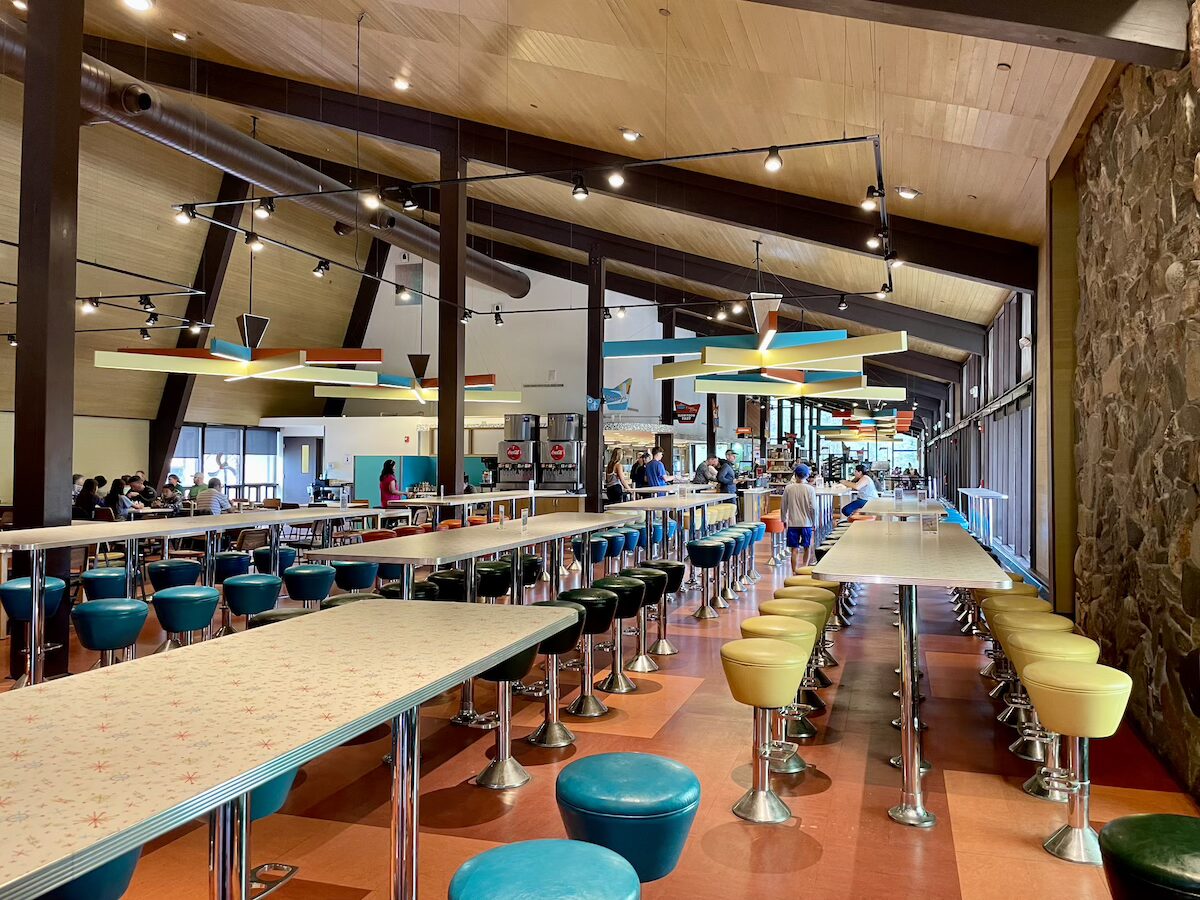
Inside the 1950s-themed Canyon Eatery. credit: Catherine Parker Canyon Eatery is an eclectic food hall with a 1950s vibe, with several dining options within. It is open from 6 a.m. to 9:30 p.m., serving breakfast, lunch and dinner.
Canyon Lodge Falls Cafe is stocked with grab-and-go items, including barista-made drinks. Open from 6 a.m. to noon.
Canyon Lodge Ice Creamery scoops up Made in Montana ice cream from Big Dipper. I recommend the Huckberry Ice Cream. Open noon to 8 p.m.
M66 Lounge serves drinks, like local beer and cider, wine and craft cocktails. It also serves small plates, a few entrees and dessert. Open 3 to 11 p.m.
Open from mid-May to late October.
Where to Camp at Canyon
Canyon Campground
Sits at an elevation of 7,900 feet (2408 m) in a lodgepole pine forest at Canyon Village. During one of my visits, I camped at the Canyon Campground. It is popular, so the sites are close together.
- Reservations recommended and open from late May to late September
- 273 sites, No RV hook-ups
- Seasonal Potable Water and Flush Toilets
- Hot Showers and Laundry Available near the Canyon Eatery Building
Camping fee starts at $30 a night, reservable through Yellowstone National Park Lodges.
What to See in Yellowstone in the Fall
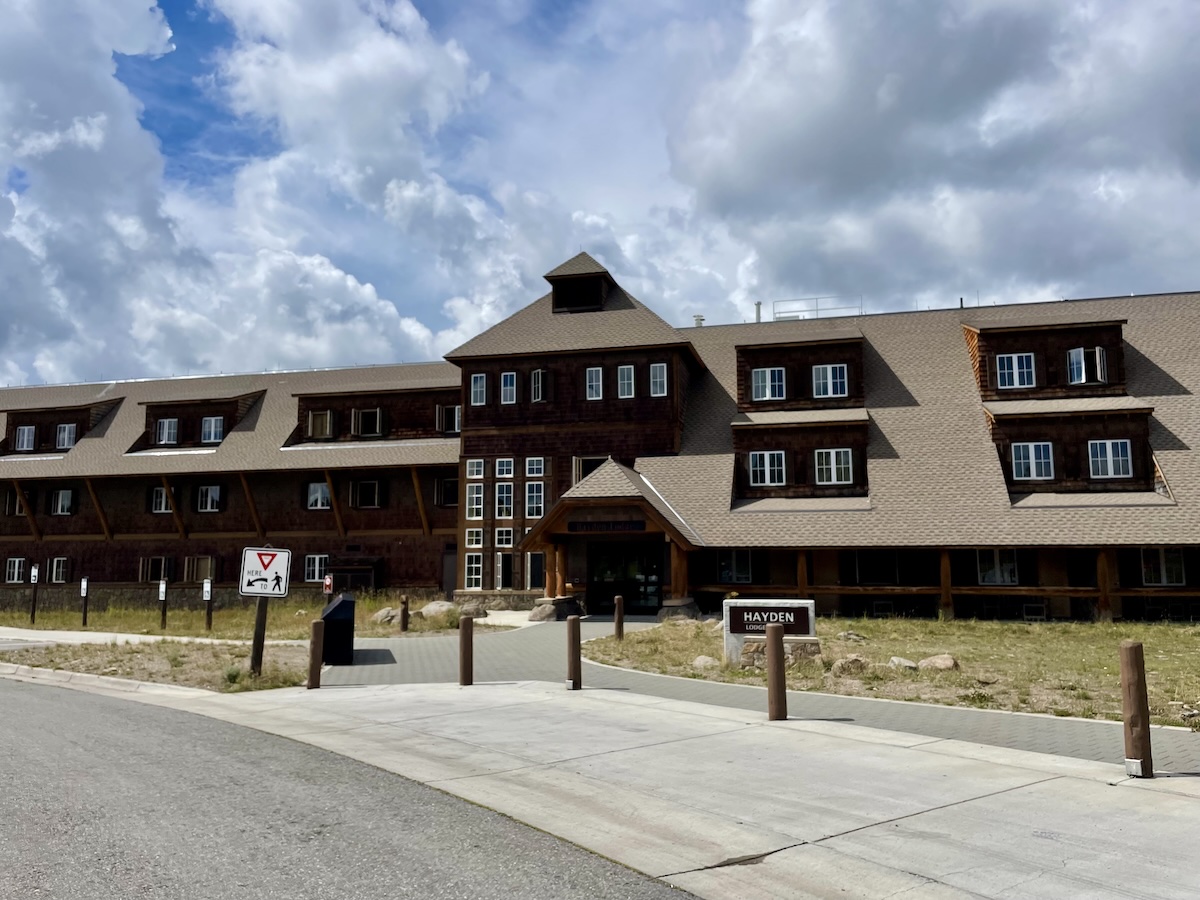
The exterior of the Canyon Lodge credit: Catherine Parker Where to Stay in Canyon
Centrally located in the park, Canyon Village has easy access to both the upper and lower loops. Canyon Lodge underwent one of the largest sustainable lodging redevelopment projects in the National Park Service. Its five lodges are LEED-certified, and three were completed in 2016.
With 500 rooms and cabins, Canyon Lodge and Cabins is a popular place to stay. It offers a range of accommodations from suites to cabins.
Rhyolite Lodge—Opened in 2016 and features EV charging.
Moran Lodge—Opened in 2016.
Washburn Lodge—Opened in 2016, this is the main building of the Canyon Lodge. It features a snack bar, Washburn Lookout.
Cascade is an older lodge
Dunraven is an older lodges
Worth noting: you can choose the type of rooms and either the older or newer lodges. However, you do not get to choose which lodge you will be assigned.
Canyon Lodge and Cabins are open from mid-May to late October.
-
History of Yellowstone National Park
On March 1, 1872, Yellowstone National Park became the first national park in the world. An idea that’s flourished across the world.
Though Yellowstone’s significance began long before. Approximately two million years ago, a supervolcano erupted in Yellowstone, forming a caldera, or basin. In the center of Yellowstone National Park, it measures 45 miles across, now home to the largest concentration of geysers in the world.
The railroad arrived at the northern edge of the park in 1883. Then the first roads started to bisect the park, allowing visitors more access to the geothermal features and the animals. More people meant more building with Lake Yellowstone Hotel and Old Faithful Inn a few of the surviving early lodges.
It was on the western frontier, so the U.S. Army built a fort to keep the law and chase away the poachers.
-
Where’s Yellowstone National Park
The majority of the park is in the northwest corner of Wyoming. Unless you arrange a tour, you will need a car to explore.
Three airports serve Yellowstone National Park.
Bozeman Yellowstone International Airport (BZN)—Bozeman, Montana, offers everything you need to outfit your family for a national park adventure, from food to equipment.
Jackson Hole Airport (JAC)—The busiest airport in Wyoming is a regional airport. Jackson is a quaint town with an Old West flavor.
Yellowstone Regional Airport (COD) in Cody, Wyoming, is a regional airport located east of Yellowstone.
Yellowstone National Park offers cafes, general stores and restaurants. Though be prepared to picnic for lunch and grab some snacks and sandwich ingredients in Bozeman or Jackson.
Getting Around Yellowstone
Yellowstone National Park is open 365 days a year and 24 hours a day. You can use an America the Beautiful annual pass ($80) or purchase a 7-day pass for $35 per vehicle for U.S. citizens and residents. For international travelers, it is an additional $100 fee per adult.
Note: Yellowstone National Park doesn’t require timed day pass entrances like some other parks.
Yellowstone National Park offers five entrances.
West Entrance—For families that are trying to add to their state count. Enter or exit through the West Entrance to add Idaho.
North Entrance—Closest entrance for Bozeman, Montana
Northeast Entrance—Scenic highway to Billings, Montana
East Entrance—Scenic highway to Cody, Wyoming
South Entrance—The busiest entrance and gateway to Grand Teton National Park and Jackson, Wyoming.
Seasonal closures affect Yellowstone National Park. Only July and August are the months when all roads and facilities are open.
All About National Park Passes
Be Bear Aware
Using their sense of smell and strength, vehicles can not keep a bear out who wants a candy bar.
Tips from Park Rangers:
- Don’t leave food or scented items in vehicles.
- Store all food or items with a scent, including toiletries, in provided bear-proof storage lockers.
- Lodge guests must bring all items indoors overnight.
- Keep a clean camp.
- Deposit all garbage in bear-proof trashcans or dumpsters.
- If you encounter a black bear, make loud noises to scare them away.

Comments are closed.