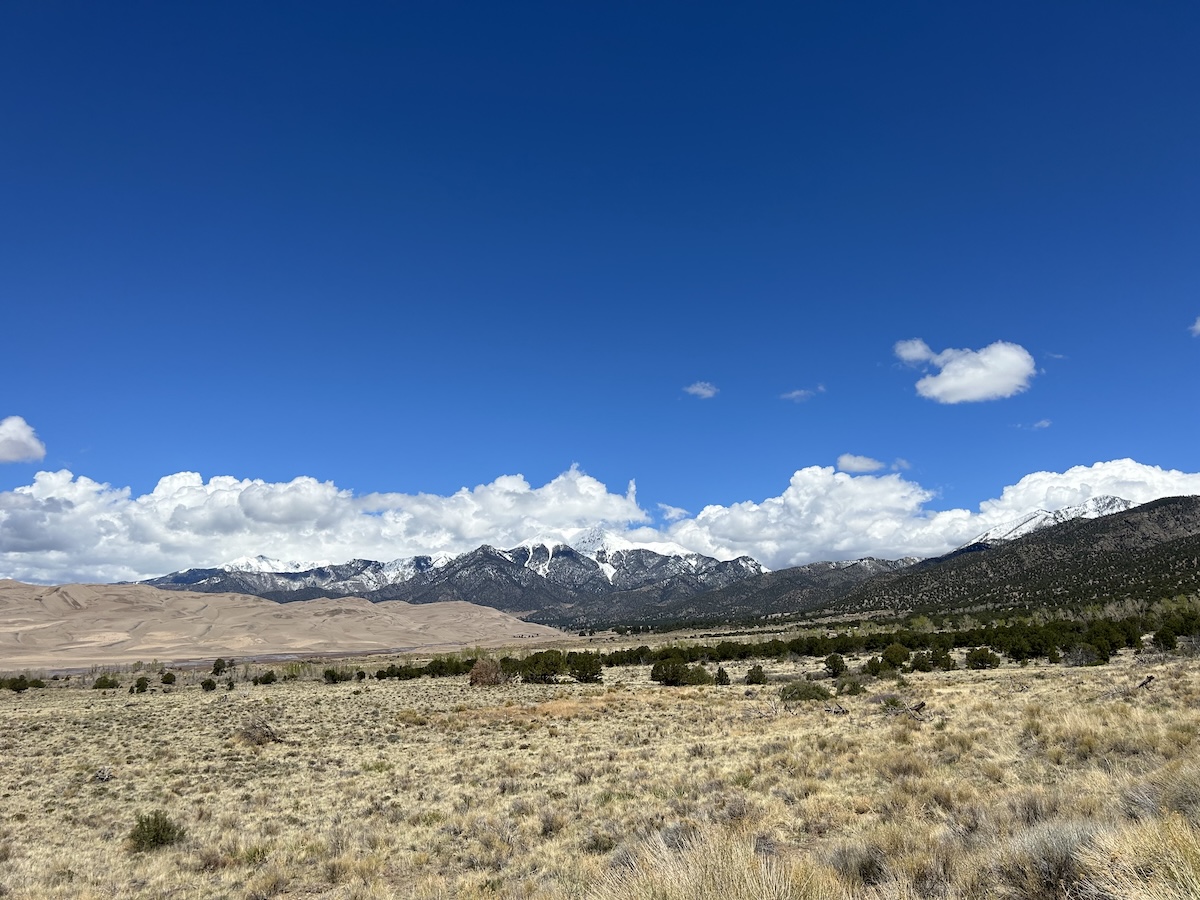
In the Sangre de Cristo Mountains of Colorado, the tallest sand dunes in North America rise up to 750 feet. These towering drifts of sand are beacons for dune surfing, dune hiking and seasonal splashing in the creek at their base. Here are the best things to do in Great Sand Dunes National Park.
Things to Do in Great Sand Dunes National Park
Learn about the Park
Stop by the Visitor Center
Scenic Drive
Explore the Sand Dunes
Take a Hike
Sand Sled or Sandboard on the Dunes
Splash in Medano Creek
Spot Wildlife
Attend a Ranger Program
Picnic in the Park
Camp in the Park
From Llama Trekking to Scenic Drives: Top 19 Things to Do in Rocky Mountain National Park

Should you Visit Great Sand Dunes National Park?
Absolutely, I have visited on at least two different occasions, as a road trip side trip. Its location about one hour east of Walsenburg at Interstate 25 makes it an easy park to visit when continuing on to Rocky Mountain National Park.
The towering sand dunes are striking in their light sand color as they pop out against the darker Sangre de Cristo Mountains that might have snow on their peaks. During my visits, my kids were keen to hike them, but it was easier said than done, as sand is notoriously hard to walk on.
How Were the Great Sand Dunes Formed?
Like many natural features, the Great Sand Dunes were created naturally over tens of thousands of years. Wind, water and sediment from a leftover lake and erosion from the mountains combined to create the largest sand dunes in North America.
Prevailing winds concentrated the sand at the base of the mountains, trapping it. The Sangre de Cristo Mountains also help the sand dunes to grow in height.
Visitor Centers in Great Sand Dunes National Park
The Great Sand Dunes Visitor Center is the place to ask questions and learn about park ranger programming. It offers a 20-minute interpretive film and a new diorama explaining the park’s ecosystems. Visitors will also find a display on the night sky and how the dunes come alive at night.
Visitor centers are the place to grab maps or Junior Ranger booklets.
Restrooms and water bottle fillers are usually located at the visitor center.
Located at 11999 CO State Highway 150, Mosca, CO. It is open daily from 9:00 a.m. to 4:30 p.m.

Great Sand Dunes National Park Hiking Trails
Hiking is one of the best ways to explore a national park site. At the visitor center, the Sand Sheet Interpretive Trail is a 0.4-mile (0.6 km) walking path.
On the dunes, there are no trails, and you can explore them at will. Worth noting, during my summer visit, it was excessively hot with the sun reflecting off the sand.
For those who yearn to find the highest dune, Hidden Dune is the tallest dune in North America at 741 feet (225 m). It is 7 miles (11 km) round trip from the Dunes Parking Lot, located off the Main Park Road.
Montville Nature Trail is a 0.5-mile loop trail through the forest, close to the visitor center. Mosca Pass Trail is a .5-mile (5.7 km) one-way trail that follows a small creek to the summit of a low pass in the Sangre de Cristo Mountains.
Sand Sledding and Sandboarding
Just like the snow, you can sled down the dunes with the right equipment. After climbing the hill, you can sit on a special sand board and ride the dune down.
Likewise, you can insert your feet into a sandboard and ride it like a snowboard. If you don’t have your own equipment, then you can rent equipment just a few miles outside the park.
Worth noting, snow sleds do not work on sand, and tend to sink or grab.
Top Things to Do at the Black Canyon of the Gunnison National Park in Colorado

Medano Creek Splashing
During part of the year, Medano Creek fills with water and is a popular place for splashing. Powered by snowpack in the Sangre de Cristo Mountains, runoff joins Medano Creek, winding at the base of the dunes.
During high snowpack years, Medano Creek meanders at the base of the dunes in a wide and shallow area. Kids can splash and float in this area.
Before planning to play in the creek, check the Great Sand Dunes National Park’s page dedicated to creek flow. It is most active during the spring.
Scenic Roads
Great Sand Dunes National Park offers paved roads and unpaved 4×4 roads. Main Park Road is just that, and the sand dunes are located off that road and it continues for 4 miles inside the park to Pinyon Flats Campground.
Farther north in the park is the Medano Primitive Road, a seasonal road closed in winter. This road requires a 4×4, not AWD. For more information, visit the getting around page of the Great Sand Dunes National Park.
Top Things to Do in Colorado Monument

Wildlife in Great Sand Dunes National Park
Wildlife spotting is one of the top activities on any national park adventure. Visitors can spot animals while hiking, especially near water sources and at dusk and dawn.
- Abert’s squirrels, jokingly referred to as “scrabbits” because of their rabbit-like ears.
- American Pikas
- Badges
- Beavers
- Bighorn sheep
- Bison
- Black bear
- Elk
- Marmots
- Mountain lions
- Mule deer
- Pronghorn
- Snowhares
Sandhill Crane Migration
One of the most notable of the 250 bird species found in Great Sand Dunes National Park, Sandhill Cranes migrate to San Luis Valley. Over 20,000 cranes spend part of their spring and fall each year in the valley.
The Sandhill Cranes spend their winters in Southern New Mexico. In February, they mate in the park before heading to the northern US and Canada in late March, where they spend the summer.
They arrive back in the park by late September. Some stay through mid-to-late November, before heading farther south into New Mexico.
Park rangers recommend visitors stay at least 25 yards from larger mammals, like deer and elk and 100 yards from predators, like Mountain lions and Black bears.
Ranger Programming at Great Sand Dunes National Park
Dive deeper into a national park site by attending a ranger program. With programming for all ages, rangers can lead hikes, guided tours and special programming for kids, the Junior Ranger Program.
The Grand Sand Dunes National Park offers ranger programs at the Visitor Center twice a day during busy season. On Saturdays, it hosts an amphitheater evening program.
Junior Ranger Program
The Junior Ranger Program is the go-to program for families to learn more about a National Park. It’s free and takes about two hours to complete.
My kids love the badges park rangers present to them after they complete their booklets. Occasionally, a national park might host special programming for kids.
BARK Program
Most National Parks welcome pets as long as they follow the BARK program’s principles. They are usually welcome at the park’s picnic area, campground, in the parking lots and on the paved roads.
In the Great Sand Dunes National Park, pets are welcome on the Mosca Pass Trail, Piñon Flats Campground, Dunes Overlook Trail, and along the Medano Pass Primitive Road.
For more information, visit the park’s page for visiting with pets. Remain mindful of the sand’s temperature in the summer; it might be too hot for animals.
B–Bag waste and dispose of it in the trash
A–Always leash your dog for their safety and others
R–Respect wildlife
K–Know where you can go
Enjoy the Night Sky
With its dry air, little light pollution and high elevation, Great Sand Dunes National Park is an International Dark Sky Park. Evening visitors can see the Milky Way during their visit if the skies are clear.
For the best night sky viewing, a little planning can go a long way. The best night skies are in August and September. Keeping the moon phases in mind is also important for night skies.
The darkest skies happen between 1 and 1/2 hours after sunset and before sunrise. Letting your eyes adjust to the dark and limiting light sources will also amplify the experience.
Picnicking in Great Sand Dunes
Come prepared with snacks and picnic supplies for lunch. The picnic area along Medano Creek is shaded, but wood fires are not permitted due to wildlife danger.
Dunes Picnic Area
Visitors will find a picnic table and charcoal grill (no wood fires). In the summer, a restroom is available in the middle of the picnic area. Restrooms are available year-round near the picnic area at the adjacent Dunes Parking Lot.
There is also a day-use area at Sand Pit Picnic Area and Castle Creek Picnic Area.
Restaurants in Great Sand Dunes National Park
Just outside of the park, the Oasis Restaurant is open seasonally from May through September. Serving breakfast, lunch and dinner, there is outdoor tables.
Located at 7800 Highway 150 N., Mosca, CO
Oasis General Store
There is also a stocked general store in the area. Visitors will find picnic supplies and a gas pump.
Camping in Great Sand Dunes National Park
Pinon Flats Campground
- Seasonal, open April 1st through October 31
- 21 sites,
- Flush toilets + No Showers
- No RV hookups, Seasonal Dump
Medano Pass Primitive Road Camping
- Seasonal, when Medano Pass is open for the season
- First-come, First-serve
- Reservation Required
- 21 sites
- Includes a fire ring and bear-proof box
Great Sand Dunes Lodge
At the entrance, the Great Sand Dunes Lodge offers views of the foothills on the Rockies’ Front Range. Visitors will see the Sangre de Cristo and other 14.000 foot peaks.
It is a seasonal lodge, open from Mid-March through October. The Great Sand Dunes Lodge offers a range of accommodations from a double-queen room to RV campers to Geo-disc Domes for glamping.
Reservations recommended. The lodge offers a place to cookout
Where’s Great Sand Dunes National Park
The Great Sand Dunes National Park is open 24 hours a day, and 365 days a year. A seven-day vehicle pass is $15, or you can use your America the Beautiful Pass to enter.
